

 Français
Best Nutrients for Cannabis Plants in 2025 (Soil, Coco & Hydro Guide)
Introduction: So Many Bottles, So Little Clarity
As soon as you start growing cannabis one of the first headaches you run into is nutrients.
You walk into a grow shop and see a wall of bottles: grow, bloom, boosters, stimulators, organic, synthetic, 1-part, 3-part, powders, liquids… and online everyone swears their favorite brand is the secret to massive, frosty buds.
So you start wondering:
What nutrients do cannabis plants actually need?
How do grow (veg) formulas differ from bloom formulas?
What are the best nutrients for cannabis plants in soil, coco, and hydroponics?
Do you really need an army of expensive additives?
The good news: you don’t need magic potions to harvest top-shelf buds. You mostly need:
The right nutrient ratios at each life stage
Nutrients matched to your growing medium (soil, coco, hydro)
Stable pH and EC
A solid base nutrient line (supplements are optional)
This guide walks you through all of that and ends with a list of recommended nutrient lines plus an advanced FAQ based on real grower experience.
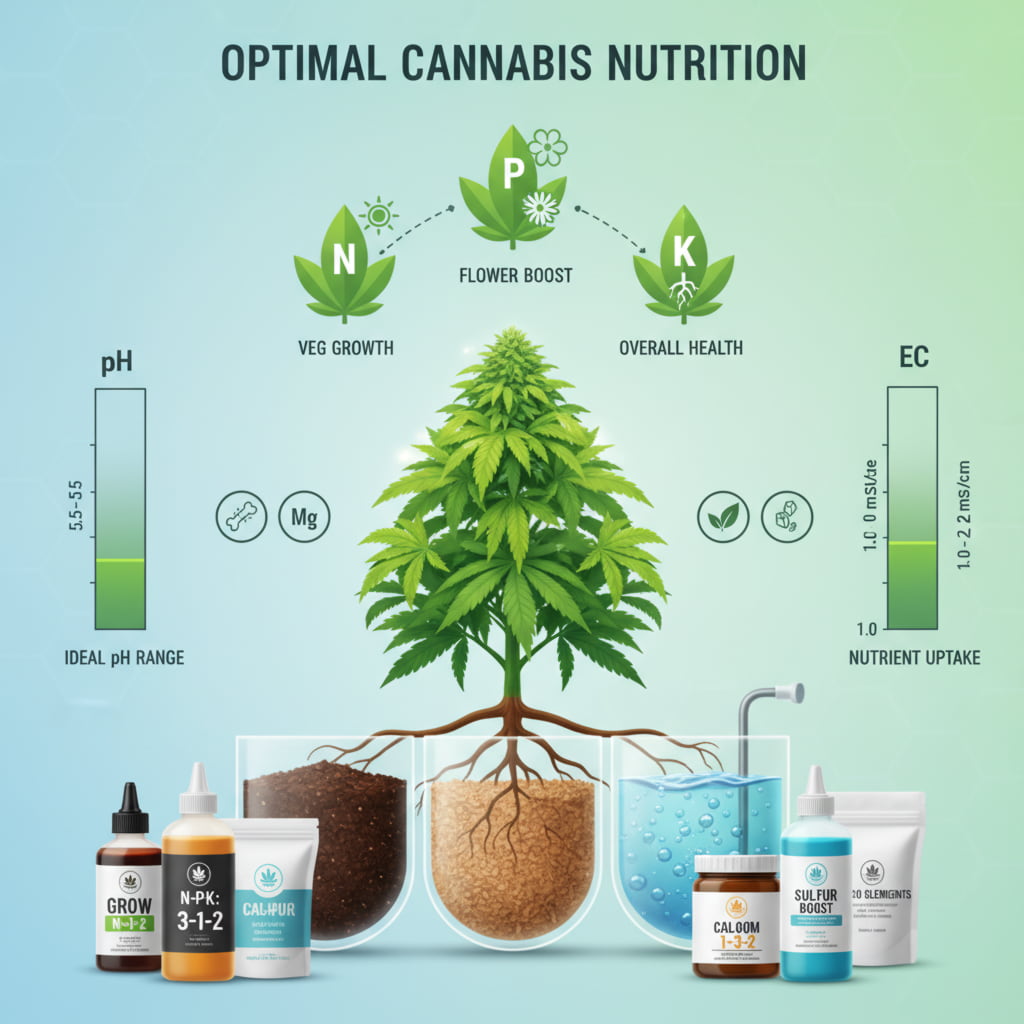
What Nutrients Do Cannabis Plants Need?
Cannabis needs the same basic elements as most plants, but in very specific proportions and at specific times.
Primary Macronutrients (N-P-K)
These are the “three numbers” on every fertilizer label:
Nitrogen (N) – leafy growth, stems, overall vigor, chlorophyll
Phosphorus (P) – root development, energy transfer, flower formation
Potassium (K) – water regulation, stem strength, bud density and weight
These three are the most important to balance between veg and bloom.
Secondary Nutrients
Needed in moderate amounts:
Calcium (Ca) – cell walls, structure, prevents some tip burn
Magnesium (Mg) – central to chlorophyll, crucial for photosynthesis
Sulfur (S) – important for enzymes and contributes to aroma and flavor
Micronutrients (Trace Elements)
Needed in tiny quantities but still essential:
Iron (Fe), Manganese (Mn), Zinc (Zn), Boron (B), Copper (Cu), Molybdenum (Mo), etc.
A good cannabis base nutrient provides all of these. You shouldn’t need to buy every element separately.
Life Stages & Nutrient Needs: Veg vs Flower
Cannabis goes through two major feeding phases, each with very different needs.
Vegetative Stage: Nitrogen in the Spotlight
In veg, the plant focuses on stems, branches, and leaves. It wants:
Lots of Nitrogen (N)
Moderate Phosphorus (P)
Steady Potassium (K)
That’s why “Grow” or “Veg” nutrients typically have a higher first NPK number (e.g., 3-1-2, 4-2-3).
When to start feeding veg nutrients:
In rich soil: often 2–4 weeks with just water while the plant uses what’s in the soil.
In coco or hydro: you usually start a very light nutrient solution as soon as the plant has its first true leaves, because the medium is inert.
If you’re new, pairing this guide with a broader <a href="https://quebeccannabisseeds.com/marijuana-growing-guide">Marijuana Growing Guide</a> makes dialing things in much easier.
Flowering Stage: Less N, More P & K
Once you flip to 12/12 (or your autos naturally transition), the plant switches from leaf production to building flowers. Now it wants:
Less Nitrogen (N) – too much N slows bloom and makes harsher smoke
More Phosphorus (P) – more bud sites and stronger flower development
More Potassium (K) – harder, denser buds and stronger plants overall
That’s why “Bloom” or “Flower” nutrients usually have a lower first number and higher P & K numbers (e.g., 1-3-2, 1-4-5).
If you grow autoflowers, you’ll see these nutrient shifts compressed into a shorter timeline. For more on that, check out guides like How Long Is the Flowering Stage for Autoflowers? and When to Harvest Autoflower Strains?
Important: past a certain point, dumping more P and K into the tank doesn’t increase yields. It just builds up in the medium and causes lockouts.
Why Are Nutrient Lines So Different?
If almost every nutrient line “works,” why do they feel so different in your tent?
1. Nutrient Ratios (the “Secret Recipe”)
Each manufacturer has its own preferred N:P:K and Ca:Mg:S ratios for each stage. That’s the “secret sauce” behind its feed chart.
Some brands shoot for a moderate EC, others push harder at peak veg and mid-flower. Two well-regarded brands can both be good—but one may simply fit your environment and genetics better.
2. Ingredient Sources & Chelates
Two bottles can have the same NPK on the label yet behave differently because:
They use different mineral salts or organic sources
They use different chelates for micronutrients
They include (or don’t include) biostimulants like kelp, humic/fulvic acids, amino acids, etc.
This affects solubility, uptake speed, and compatibility with soil, coco, and hydro systems.
3. Designed for Soil vs Coco vs Hydro
Some lines assume that soil already supplies trace elements and plays a buffering role. Others, designed for coco and hydro, are 100% complete and must provide everything through the solution.
“Soil” nutrients: often milder and designed to work with soil biology
Coco/hydro nutrients: designed so the solution alone provides everything
That’s why using a slow-release “houseplant fertilizer” or coated pellets in DWC is a very bad idea.
Matching Nutrients to Your Medium
Choosing the best nutrients for cannabis plants starts with matching them to how you grow.
Soil
Pre-amended soil can feed your plants for 2–4 weeks.
Soil often contains organic matter and trace elements that buffer pH.
Most soil growers prefer milder and/or partially organic lines.
Good fit: soil-specific or “all-purpose cannabis” nutrients, possibly with a bit of Cal-Mag if your water is very soft.
If you’re just starting from seed, pair your nutrient plan with a solid germination process like How to Germinate Cannabis Seeds
Coco
Coco holds air and water very well but contains zero nutrients.
It binds calcium and magnesium easily, so those must be managed carefully.
It behaves like a hybrid between soil and hydro: you feed almost every watering into a free-draining medium.
Good fit: coco-specific or hydroponic lines, often with regular Ca/Mg support.
Hydroponics (DWC, NFT, drip systems, etc.)
Roots sit directly in a nutrient solution.
There’s no “soil safety net,” so pH and EC must be precise.
The solution needs to deliver all macros, secondary nutrients, and micros in the right form.
Good fit: clean, fully soluble hydro nutrients, usually in 2- or 3-part systems.
If you’re focused on hydro, it’s worth reading a dedicated guide like How to Grow Hydroponic Weed alongside your nutrient plan.
Organic vs Synthetic, Liquid vs Powder, Single-Part vs Multi-Part
Organic vs Mineral (Synthetic) Nutrients
Organic:
Derived from natural sources (composts, guanos, plant extracts, manures…)
Works best in living soil, where microbes convert organic matter into plant-available nutrients
Often associated with richer terpene profiles when the soil system is dialed in
Poor fit for recirculating hydro systems (clogs, biofilm, slime)
Mineral / Synthetic:
Purified salts designed for fast uptake
Ideal for coco and hydro, where solubility and precision are critical
Easy to monitor via EC/PPM
Easier to burn plants if you push too hard
There is no universal “better.” It depends on your system and goals: organic super-soil for flavor and simplicity, mineral salts for speed and tight control.
Liquid vs Powder Nutrients
Liquids:
Very convenient to measure
Perfect for small grows and beginners
Shorter shelf life, more storage volume
Powders:
Highly concentrated and very cost-effective
Long shelf life, compact to store
Require accurate weighing and mixing, but excellent for large gardens
Single-Part vs Multi-Part Nutrients
Single-part:
Everything in one bottle or bag
Ultra convenient and beginner-friendly
Less fine control over individual ratios
Two-part / three-part:
Separates nutrient families (Micro/Grow/Bloom, A/B, etc.)
Lets you adjust ratios over time (more Grow in veg, more Bloom in flower)
Slightly more mixing work, but far more flexible
In cannabis, 2-part or 3-part hydro lines are very popular because they let you tune N/P/K and Ca/Mg precisely to each stage.
Recommended Nutrient Lines for Cannabis (Soil, Coco & Hydro)
Here are complete base lines that have been widely used on cannabis. Start with a base; only add supplements when you actually need them.
1. General Hydroponics – Flora Series (FloraMicro, FloraGro, FloraBloom)
Best for: Soil, coco, hydro (DWC, RDWC, drip, DTW)
Skill level: Beginner → advanced
Highlights:
Classic 3-part system used in countless grows
Clean, fully soluble, works in nearly any system
Clear feed charts; easy to tweak ratios for different strains
Pairs nicely with a Cal-Mag and a root health product in hydro
In practice:
If you want a flexible, heavily proven line, Flora is a rock-solid choice.
2. Dyna-Gro / SuperThrive – Foliage-Pro + Bloom
Best for: Soil, coco, hydro
Skill level: Perfect for beginners
Highlights:
Only two bottles: Foliage-Pro for veg, Bloom for flower
Complete formulas (macro + micro) that cover the entire cycle
Runs clean in coco and hydro as well as soil
Great for growers who hate complicated feed schedules
In practice:
If you want pro results with minimal bottles, this duo is excellent.
3. FoxFarm – Liquid Trio (Big Bloom, Grow Big, Tiger Bloom)
Best for: Soil and coco in hand-watered pots
Skill level: Beginner / intermediate
Highlights:
Hybrid of mineral nutrients with organic inputs (guano, castings, etc.)
Pairs very well with rich soils, often with great flavor outcomes
Easy to find, with official feed charts
Note:
The classic trio can be a bit “dirty” for DWC or recirculating systems; it shines in pots.
In practice:
In soil or coco, if you want a hybrid organic/mineral approach with strong flavor, FoxFarm is a solid option.
4. CANNA – Coco A & B
Best for: Coco (DTW or recirculating)
Skill level: All levels
Highlights:
Formulated specifically for coco, with Ca/Mg and trace elements dialed in
Two-part base (A+B) that covers the entire grow
Compatible with most coco additives and occasional Cal-Mag top-ups in very soft water
In practice:
If you grow only in coco, CANNA Coco is a simple, stable, widely used solution.
5. Botanicare – Pure Blend Pro & KIND
Best for: Soil, coco, hydro
Skill level: Intermediate
Highlights:
Pure Blend Pro Grow/Bloom: hybrid mineral + organic base, loved in soil and inert media
KIND Base/Grow/Bloom: more modular, with separated nitrogen and calcium control for true fine-tuning
Botanicare is also known for strong root-health products
In practice:
If you want a slightly more technical line with great root support, Botanicare is worth a look.
6. House & Garden – A/B Lines
Best for: Larger soil, coco, or hydro gardens
Skill level: Intermediate / advanced
Highlights:
Dutch formulas developed and tested on cannabis
Different A/B bases for each system (Soil A+B, Coco A+B, Aqua Flakes A+B, Hydro A+B)
Serious yield and quality potential when used with their additives (Roots Excelurator, Bud-XL, Shooting Powder…)
In practice:
For serious or semi-commercial setups running a full feed program, H&G is top-tier.
7. Modern Cannabis-Specific Hydro Lines
(Examples: Transplant / Veg / Bloom / Ripen style programs, Growcycle-type lines, etc.)
Best for: Hydro and coco systems
Skill level: Intermediate
Highlights:
Designed from the ground up around the cannabis life cycle, with stage-specific formulas
High-purity inputs, often targeting around 1.5 mS/cm in the root zone for quality production
Aim to simplify hydro nutrition while maximizing consistency
In practice:
If you’re doing true hydro and want nutrients tailored to cannabis physiology, these newer lines are a great fit.
Honorable Mentions (SEO-friendly but still useful)
You can also briefly mention:
Advanced Nutrients (pH Perfect, Jungle Juice) – Cannabis-focused, self-buffering pH around ~5.5–6.3 in coco/hydro; huge supplement catalog.
Jack’s Nutrients – Very economical powders, often run as 3-2-1 or simple 20-20-20 then 10-30-20.
Mega Crop (Greenleaf) – Popular 1-part dry nutrient for its simplicity and cost.
Technaflora, Nectar for the Gods, Humboldt’s Secret A+B – Well-reviewed complete lines, especially for soil/organic-leaning substrate systems.
Watering Basics: pH, EC & “How Much Is Too Much?”
Even the best nutrient line is useless if your pH and EC are out of range.
Target pH Ranges
Soil: 6.0 – 7.0
Coco & hydro: 5.5 – 6.5
Cannabis can only absorb nutrients efficiently inside these ranges. Outside them, deficiencies appear even when the nutrient mix is correct.
Rough EC / PPM Guidelines
Seedlings / clones: ~0.4 – 0.8 EC
Veg: ~1.0 – 1.6 EC
Bloom: ~1.4 – 2.0 EC (varies by strain and environment)
Many experienced growers recommend aiming for around 1.5 mS/cm in the root zone as a safe and productive zone. Above that, risks climb.
Key trick:
Compare the EC going in vs the EC coming out (runoff or return):
Runoff EC much higher than feed EC = salts are building up (overfeeding).
Runoff EC much lower = hungry plants or a medium that doesn’t hold anything.
If you want to dive deeper into root health specifically, pairing this with Understanding the Cannabis Root System is a smart move.
Big Nutrient Myths (That Cost You Money)
“More nutrients = bigger buds.”
Past a certain point, raising EC just burns tips and causes lockouts.“You need tons of additives to grow good weed.”
A solid complete base is enough. Boosters are fine-tuning tools, not mandatory.“Organic bottles always taste better.”
Flavor depends heavily on drying, curing, genetics, and the whole soil system—not just the word “organic” on the label.“Deficiency = always feed more.”
Most “deficiencies” come from pH or root-zone issues, not from a lack of product in the bottle.“You can’t grow top-shelf cannabis with cheap nutrients.”
Wrong. Many commercial growers use inexpensive dry salts. Accuracy and consistency matter more than brand price.
Frequently asked questions
1. Can Cannabis Store Nutrients and Smooth Out Mistakes?
Yes. Cannabis can store nutrients in its tissues and move them around:
If external supply drops, the plant recycles N, P, K, and some micros from older leaves into new growth and flowers.
That’s why deficiency symptoms don’t appear instantly after a bad watering.
Once reserves are depleted and the medium still doesn’t supply enough, older leaves yellow, spot, and die as the plant tries to finish its life cycle.
2. How Do I Tell Deficiency from Excess?
Look at where and how symptoms appear:
Older leaves yellow first: often a nitrogen deficiency, as N is mobile and moves upward.
New leaves pale while older ones stay green: often Ca, Mg, Fe, or another low-mobility element.
Yellowing between the veins (interveinal chlorosis): often linked to Mg, Fe, or Zn.
Brown spots / burned edges: typical of K, Ca, or Mg issues.
Dark clawed leaves with burned tips: usually excess nitrogen / overfeeding.
Always check first:
pH in the correct range
EC in the root zone not crazy high or low
No chronic overwatering / suffocated roots
Fix those before throwing more bottles at the problem.
3. Why Do People Say to Stick to One Brand at First?
Because each brand:
Targets different ratios
Uses different chelates and stabilizers
Balances Ca/Mg and micros its own way
Mixing several lines at random is a great way to cause precipitation, imbalances, and weird symptoms that are hard to diagnose.
For a first grow, it’s best to stick with one complete line and its feed chart. Once you’ve mastered that, you can start experimenting.
4. How Should I Think About Supplements?
Treat supplements as targeted tools:
Cal-Mag: prevents/fixes Ca/Mg issues, especially in coco, RO water, or under certain LEDs
PK boosters: extra phosphorus/potassium in mid/late flower
Microbial inoculants & enzymes: protect roots, clean up salts, improve availability
Silica: stronger stems, better stress resistance
Smart strategy:
First, dial in your base, pH, and EC
Add one supplement at a time and watch the plant for at least a week
Reduce or remove if you see burn or no benefit
Avoid buying 10 bottles “just because.” That usually makes things harder, not better.
5. Are Super-Soil and Living Soil Worth It?
If you like organics and simplicity, absolutely.
Super-soil / living soil:
Is pre-loaded with composts, amendments, guanos, etc.
Often lets you water with plain water for much of the grow
Uses microbial life to buffer pH and release nutrients slowly
Can produce very rich terpene profiles when done well
Downside:
You have less real-time control. If something goes wrong, it’s slower to fix than adjusting a hydro reservoir.
6. Does Water Quality Really Matter?
A lot.
Hard water often already contains Ca and Mg, so you may need less Cal-Mag.
Very soft or RO water needs extra Ca/Mg and some buffering to stabilize pH.
High sodium or bicarbonate levels can cause long-term issues in soil and hydro.
If you want to get the most out of your nutrient line, know your water—at least its EC and mineral content.
7. Biggest Beginner Nutrient Mistakes?
Quick checklist:
Using slow-release fertilizers or “3-month feed” potting soil
Following feed charts at 100% strength instead of starting at 50–75%
Ignoring pH and blaming the brand for deficiencies
Buying every booster in the shop before mastering the base
Never checking runoff or reservoir EC
If you simply:
Choose a good base matched to your medium
Follow the feed chart at reduced strength
Keep pH in range