
 Français
How to Grow Cannabis Seedlings in Coco Coir
Coco coir is one of the most popular media for growing cannabis because it combines fast root-zone oxygenation with strong moisture retention. For seedlings, that can be a major advantage: roots get access to air, the medium stays evenly moist when managed properly, and young plants can establish quickly without the compaction problems often seen in heavier mixes.
That said, Coco is not “soil,” and seedlings should not be treated like they are in soil. Coco behaves more like a hydroponic medium. It needs proper preparation, gentle but regular feeding, and careful watering habits from the very beginning. Once you understand those differences, growing cannabis seedlings in coco coir becomes much easier and much more consistent.
Why Coco Coir Works Well for Cannabis Seedlings
Coco coir is valued in horticulture because it provides a strong balance of porosity, moisture retention, and re-wetting ability. In cannabis production, coir is commonly used from propagation all the way through harvest. A recent review of soilless media for cannabis notes that coir has high porosity, good moisture retention, and favourable hydraulic properties, while also supporting beneficial root-zone microbes. View the review.
Research has also shown that coir can work very well in cannabis production. In one indoor cannabis trial, coir-based substrates were found to be effective during the vegetative stage, and a drier coir-based substrate delivered a 29% higher flowering yield in that study. Read the study.
Another cannabis study comparing peat-mix, peat plus green fibre, and 100% coco coir found that cannabinoid content did not differ significantly across the tested substrates for the studied genotypes, showing that coir can be a viable production medium when managed properly. Read the study.
The Most Important Rule: Start With Properly Prepared Coco
This is where many growers go wrong. Coco can hold onto calcium and magnesium, and lower-quality coco may also contain excess sodium or potassium. If the coco is not washed and buffered, seedlings can struggle early, even when everything else looks correct.
Scientific literature on coir notes that the medium may need leaching and buffering so the cation exchange sites are preloaded with calcium and magnesium rather than stripping them from your first feedings. Treated coir has also outperformed untreated coir in nursery production. Cannabis media review | Treated vs untreated coir study.
Best practice: use a reputable, pre-buffered coco coir product. If your coco is not pre-buffered, rinse it well and buffer it before planting. This one step can prevent a lot of seedling problems that growers mistake for weak genetics or nutrient burn.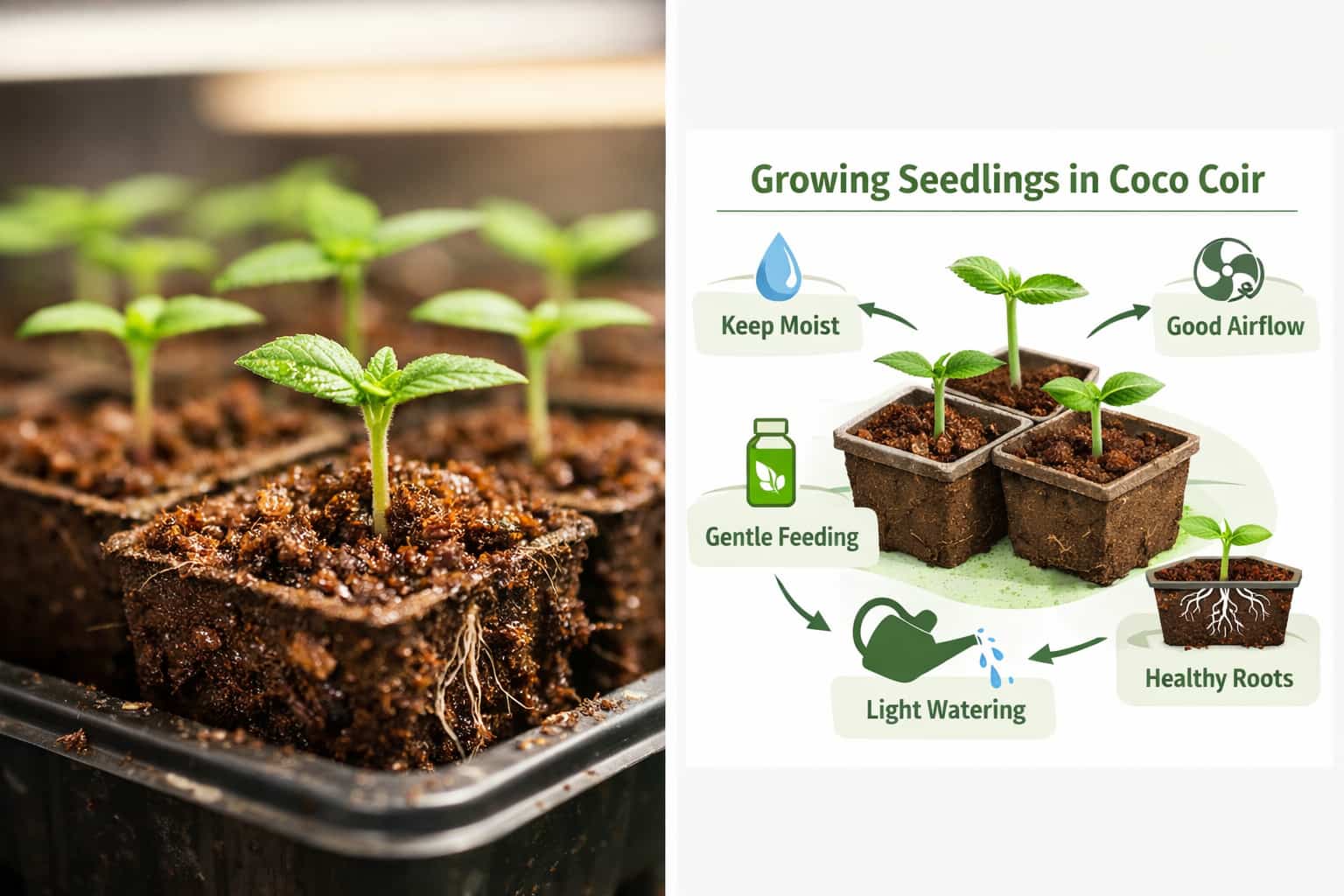
What You Need Before You Start
- High-quality buffered coco coir
- Small starter pots, propagation plugs, or solo cups with drainage
- A light nutrient solution suitable for coco
- A calcium-magnesium supplement if your nutrient line does not already account for coco
- Clean water
- Gentle seedling lighting
- A stable environment with warmth, moderate humidity, and light airflow
How to Plant Cannabis Seeds in Coco Coir
1. Pre-moisten the coco
Do not plant into dry coco. Moisten the medium evenly first so it feels uniformly damp but not muddy or saturated. Seedlings like consistency. If one part of the container is dry and another is soaked, early root growth can become uneven.
2. Fill small containers first
Start in a small container instead of a large final pot. This makes it easier to control moisture around the young root zone. Seedlings in oversized containers often stay wet for too long near the center while the upper zone dries unpredictably.
3. Plant shallow
Place the seed about 0.5 to 1 cm deep, then lightly cover it with coco. Do not pack the surface hard. You want the seed secure, but you also want oxygen around it.
4. Keep the top zone evenly moist
During emergence, the top layer matters. If the upper zone dries completely, the sprout can stall. If it stays soaked, oxygen drops and damping-off risk increases. Aim for lightly moist, not soaked.
How to Water Cannabis Seedlings in Coco
The biggest beginner mistake with coco seedlings is watering like soil one day and hydro the next. Coco likes consistency. Seedlings do best when the root zone stays gently moist and well-aerated rather than swinging between bone-dry and waterlogged.
Early on, water in small amounts and in a small circle around the seedling. You are not trying to saturate the whole container every time. You are trying to maintain a healthy moisture zone near the root system while encouraging the roots to expand.
As the seedling develops more leaves and roots, you can gradually increase the watering volume and cover a wider area of the container. Once the plant is established, coco generally performs best with regular irrigation rather than long drybacks.
Simple watering approach for seedlings in coco
- Keep the medium evenly moist, never muddy
- Water lightly and frequently rather than heavily and rarely
- Avoid letting the small root zone dry completely
- Increase volume only as root mass increases
- Make sure containers drain well every time
How to Feed Cannabis Seedlings in Coco Coir
Coco is not a nutrient-rich soil. That means seedlings usually need gentle nutrition sooner than they would in a rich potting mix. However, the word here is gentle. Seedlings do not need aggressive feeding.
Start with a light seedling-strength nutrient solution designed for coco, or use a very mild first feed from a coco-compatible nutrient line. Because Coco can affect calcium and magnesium availability, many growers also include a light Cal-Mag source unless their base nutrient already handles that requirement.
If your seedling tips burn, growth slows, or leaves get dark and clawed very early, you are probably feeding too hard. If the seedling becomes pale, weak, or stalls despite correct watering, the feed may be too weak or the coco may not have been properly buffered.
Good early feeding habits
- Use a nutrient line intended for coco
- Begin at light strength
- Do not overreact and keep changing formulas every day
- Watch the new growth more than the oldest cotyledons
- Keep the root zone stable before increasing feed strength
Light and Environment for Coco Seedlings
Seedlings in coco coir do best under a gentle, stable environment. Keep them warm, avoid major temperature swings, and provide soft but sufficient light. Seedlings do not need intense lighting on day one. They need enough light to stay compact and healthy without being pushed too hard before the roots are ready.
Gentle airflow is also important. A soft breeze helps strengthen stems and reduces stagnant conditions around the medium surface. Just do not blast seedlings with direct, strong airflow, especially right after emergence.
If you use a humidity dome, remove or vent it as the seedlings establish. Prolonged stagnant, overly wet conditions can create weak stems and fungal issues.
When to Transplant Seedlings From Coco Starter Pots
Transplant once the seedling has built a small but healthy root system and is watering out faster than it was a few days earlier. You do not want it root-bound, but you also do not want to transplant so early that the root ball falls apart.
A good sign is when the plant has multiple true leaf sets, the stem looks sturdier, and the container is drying more evenly because the roots are actively using moisture. At that point, move into a larger coco container and continue with a gentle veg feeding approach.
Common Mistakes When Growing Cannabis Seedlings in Coco Coir
Using unbuffered Coco
This is one of the most common causes of early seedling issues in coco. Poorly prepared coir can interfere with calcium and magnesium availability and may carry excess salts.
Watering too heavily in large containers
Seedlings have tiny roots. Saturating a large pot can leave the medium wet for too long and reduce oxygen near the young root zone.
Feeding too hard too early
Coco seedlings need access to nutrition, but they do not need strong feeding in the first days of life.
Treating coco like soil
Coco is a soilless medium with different water and nutrient behaviour. Soil habits often cause coco problems.
Letting the medium swing from soaked to dry
Consistency matters. Extreme wet-dry swings can stall seedling growth.
What Healthy Cannabis Seedlings in Coco Look Like
- Short, sturdy stems instead of stretched, weak growth
- Bright green new growth
- Leaves that open and expand steadily
- Daily visible progress
- A root zone that stays moist and airy, not swampy
If your seedlings are compact, upright, and adding new growth every few days, your coco setup is likely on the right track.
Scientific Studies and Reviews on Coco Coir
If you want to strengthen this article with research-backed reading, here are several useful studies and reviews on coco coir and soilless cannabis media:
- Caplan, Dixon & Zheng (2019) – Coir-based growing substrates for indoor cannabis production
- Burgel, Hartung & Graeff-Hönninger (2020) – Impact of different growing substrates on growth, yield and cannabinoid content of two Cannabis sativa genotypes
- Malík & Tlustoš (2025) – Soilless Growing Media for Cannabis Cultivation
- Mariotti et al. (2020) – Coconut coir as a sustainable nursery growing media for seedling production
- Poulter (2014) – Quantifying differences between treated and untreated coir substrate.
Frequently asked questions
Why use coco coir for cannabis seedlings?
Coir provides a strong balance of porosity, moisture retention and re-wetting ability, and supports beneficial root-zone microbes, according to a review cited in the guide.
Can coir be used for the whole grow?
Yes. Coir is commonly used from propagation all the way through harvest.
Does coir improve yield?
In one indoor trial cited in the guide, a drier coir-based substrate delivered 29% higher flowering yield. Results vary with setup.
Where can I read the studies?
The guide links to the review and studies it cites.